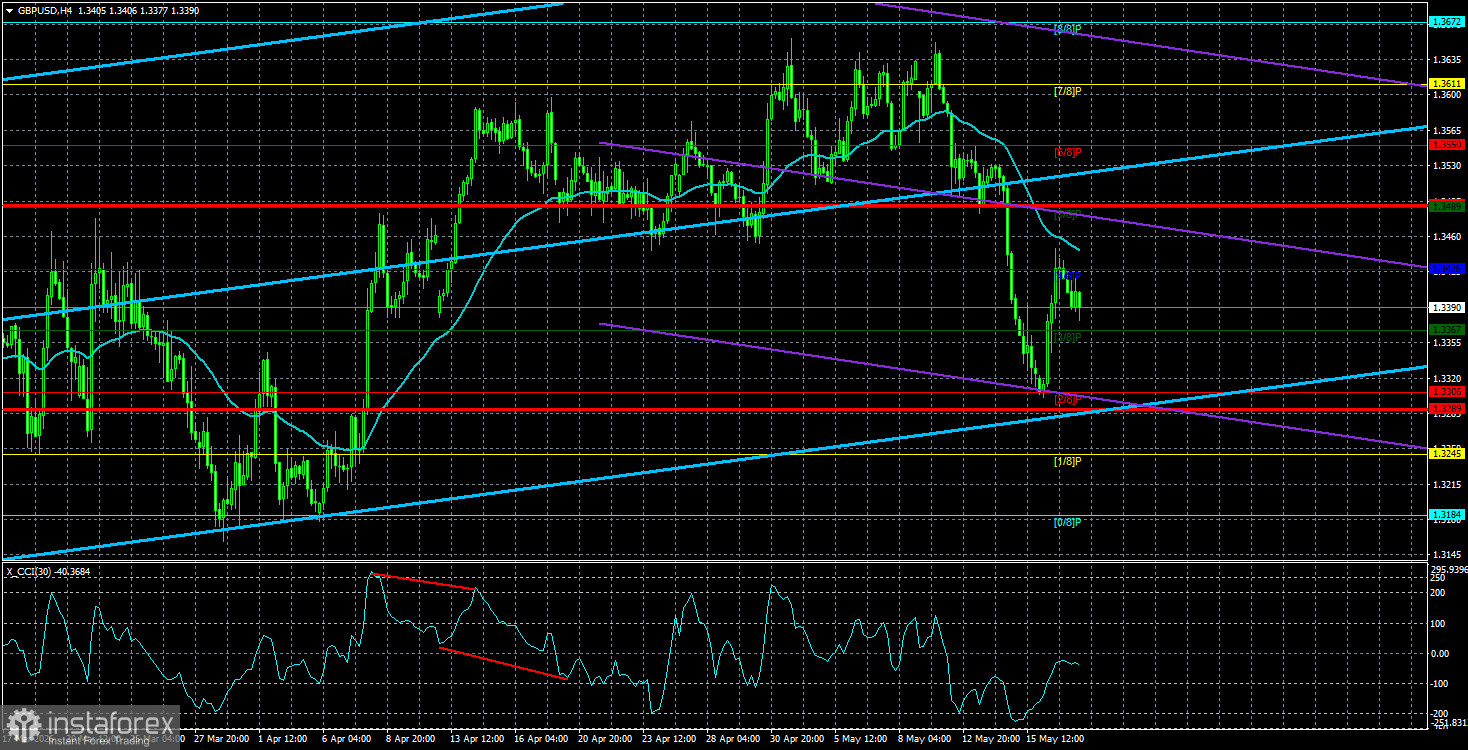
The GBP/USD currency pair attempted to resume its downward movement on Tuesday, but with too much uncertainty. The British pound entered a challenging fundamental situation last week, resulting in a 3-cent decline against the U.S. dollar. However, over the weekend, we indicated that we do not believe in further growth of the American currency, unless the war in the Middle East resumes. Let's recall what led to the British currency's fall last week.
Firstly, there was yet another political crisis in the UK. Keir Starmer's party suffered a significant defeat in the local elections, and around 40 party members called for Starmer's resignation. While Starmer did not step down, the crisis is evident. Secondly, the geopolitical situation sharply deteriorated last week. Another round of negotiations between Iran and the U.S. ended in failure, and the market began preparing for a new round of conflict. Thirdly, last week it was revealed that U.S. inflation accelerated to 3.8%, which slightly increased hawkish expectations regarding the Federal Reserve's monetary policy. Fourthly, at the end of last week, forecasts for British inflation in April were released, indicating that the UK consumer price index could slow to 3%, making it nearly impossible for the Bank of England to tighten policy, a market expectation that had been actively anticipated in recent weeks.
These four factors led to a 300-pip decline in the pound sterling. However, one could say that all these factors have already been priced in. The market is prepared for weak inflation in the UK, the BoE's abandonment of tightening policy, a potential renewal of the war in the Middle East, and even for the Fed's rate hike by the end of the year. On what basis does the dollar intend to strengthen further? As we have already mentioned, it is only based on the resumption of the war between Iran and the U.S.
By the way, the British inflation report will be released this morning, and we believe that traders may be in for a big surprise. If inflation indeed drops to 3%, we think the market has already priced it in. If inflation falls below 3%, the BoE may return to easing monetary policy, which could put additional pressure on the pound. If inflation turns out to be above the forecast, then the degree to which it exceeds expectations will matter. Between 3.1% and 3.3%, the figure could be considered neutral. Above 3.3% would indicate that inflation is accelerating, compelling the British central bank to raise the key interest rate. In this latter case, the British pound could resume its growth.
Of course, we should not overlook the geopolitical factors. We would have long stopped paying attention to Donald Trump's statements and various insider information, as in most cases, this information is unconfirmed, overtly false, or simply used by Trump as leverage against Iran. However, the market continues to react to it, which is why movements in the currency market continue to depend on geopolitical news that is nearly impossible to predict in advance.
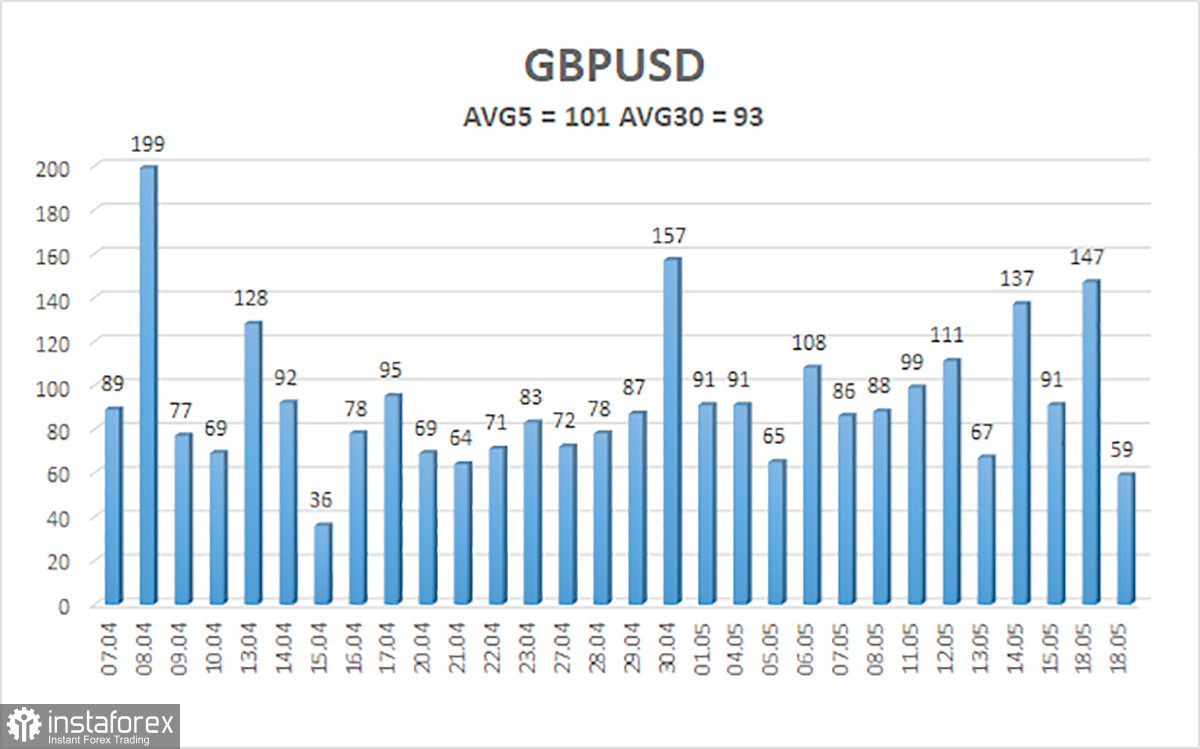
The average volatility of the GBP/USD pair over the last 5 trading days is 101 pips. For the pound/dollar, this value is considered "average." On Wednesday, May 20, we expect movement within a range bounded by levels 1.3289 and 1.3491. The upper channel of the linear regression has turned upward, indicating a recovery of the bullish trend. The CCI indicator has not formed any signals recently.
Nearest Support Levels:
- S1 – 1.3367
- S2 – 1.3306
- S3 – 1.3245
Nearest Resistance Levels:
- R1 – 1.3428
- R2 – 1.3489
- R3 – 1.3550
Trading Recommendations:
The GBP/USD currency pair has sharply declined, making the bullish trend currently irrelevant. Trump's policies will continue to exert pressure on the U.S. economy, so we do not expect the dollar to strengthen in the long term. However, 2026 is proving to be super positive for the dollar so far. Thus, long positions targeting 1.3550 and 1.3611 can be considered when the price is above the moving average. If the price is below the moving average line, short positions with targets of 1.3306 and 1.3289 can be traded on technical grounds. The market situation has turned upside down in just one week.
Explanations for the Illustrations:
- Linear Regression Channels: Help define the current trend. If both are directed in the same direction, it indicates a strong trend.
- Moving Average Line (settings 20,0, smoothed): Determines the short-term trend and direction in which trading should be conducted.
- Murray Levels: Target levels for movements and corrections.
- Volatility Levels (red lines): Likely price channel where the pair will trade in the coming days based on current volatility metrics.
- CCI Indicator: Its entrance into the oversold zone (below -250) or the overbought zone (above +250) indicates that a trend reversal is approaching in the opposite direction.